Architecture
Inspired by human role-based workflows, QuIDBBIDS defines a hierarchy of specialized modules — Coordinator, Manager, Worker, and Controller — designed to minimize workflow and BIDS-related overhead for developers implementing new methods in Worker modules, as illustrated below.
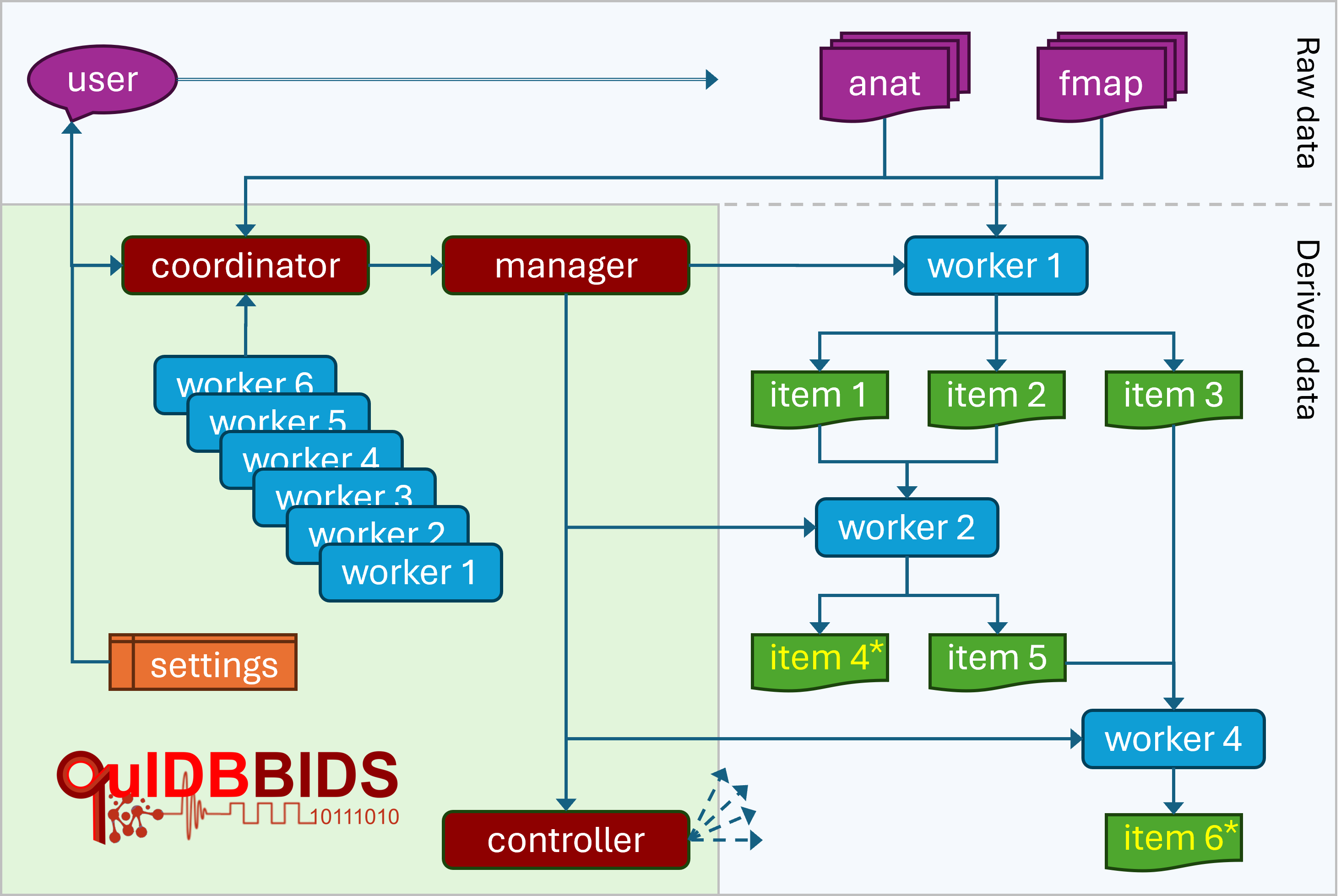
QuIDBBIDS Workflow Architecture. The user specifies the data and desired workitems (4* and 6*)
to the coordinator. The coordinator inspects the worker pool, interacts with the user to edit settings
(algorithm parameters and additional metadata), and activates the manager. The manager puts workers 1,
2, and 4 into a team and directs them to process the input data (“anat” and “fmap”), collaboratively
producing workitems 1–6. Finally, the manager initiates a controller to verify successful completion.
Coordinator module — The coordinator is named “QuIDBBIDS” and serves as the primary interface with the user, and assists in defining data management and processing options. This centralized coordination enhances the reproducibility and transparency of all executed workflows.
Manager module — Based on the resumes of the Workers and the user’s declared output requests, the manager assembles a “team” of workers that collectively define a workflow — a network of interconnected work-items linking raw inputs to the requested results. The manager then orchestrates workflow execution on a per-subject basis, either sequentially on the local system or in parallel on a high-performance computing (HPC) cluster. Data access is automatically managed via locking and release mechanisms to ensure safe parallel operation. The manager monitors progress, oversees error logs, and directs the Controller to generate comprehensive quality control (QC) reports for all completed tasks.
Worker modules — Each worker represents a modular processing unit and maintains a resume that specifies the work-items it requires (for example, a coregistered B1 field map or magnitude and phase GRE data) and the work-items it produces (such as an R2* or R1 map). Workers communicate through inherited methods of the base worker module, allowing them to request required work-items from their peers. Upstream workers are triggered recursively when their outputs are needed, and existing items are reused unless forced recomputation is requested. Throughout execution, standardized logs ensure traceability and reproducibility.
The QuIDBBIDS workflow is designed to be modular and flexible, allowing users to easily customize and extend the processing workflow by adding new Worker modules or customizing existing ones. This architecture resembles a plugin-based microservices approach, where each worker operates independently while collaborating to achieve the desired outcome.